Fructanase
Detection enzymes and reagents
Product Overview
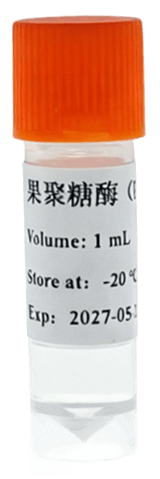
A GH32-family enzyme that hydrolyzes β-2,6-fructofuranosidic bonds in fructans, producing fructooligosaccharides and some fructose.
Reference price: ¥40 / mL
Technical Overview
Fructanase belongs to glycoside hydrolase family GH32. The product document describes hydrolysis of β-2,6-fructofuranosidic linkages in fructans, producing fructooligosaccharides and some free fructose. The degree of hydrolysis depends on substrate structure and reaction conditions.
This enzymatic route can be evaluated as an alternative to acid hydrolysis in food and bioprocessing studies, where milder conditions and control of product distribution may be useful.
Specifications
- Activity ≥3,500 U/mL
- Protein concentration: 5 mg/mL
- Purity ≥99%
- Liquid formulation
Applications
- Fructooligosaccharide preparation
- Food and bioprocessing
- Fructan hydrolysis research
Product Features
- Enzymatic hydrolysis of fructans
- Suitable for fructooligosaccharide preparation
- Recombinant expression
- Activity ≥3,500 U/mL
Source and Storage
- Source
- Recombinantly expressed in E. coli and purified after fermentation.
- Storage
- Store at −20°C and avoid repeated freeze–thaw cycles. Short-term storage at 4°C is possible.
Frequently Asked Questions
What are the main fructanase sources?
The source FAQ contrasts traditional extraction with recombinant production. Double Win's enzyme is expressed recombinantly, fermented and purified; the cited research data include expression of 100 mg/L and activity of 3,948 U/mL.
How does recombinant fructanase differ from extracted enzyme?
Natural-source extraction may be affected by raw-material supply and batch variation. Recombinant production is intended to improve expression, activity, reliability and process suitability.
What does fructanase do?
It hydrolyzes fructan glycosidic bonds to produce fructose-containing fragments or fructooligosaccharides. Endo- and exo-acting forms differ in how they cut the substrate; product-specific substrate specificity should be checked in its technical data.
How do their activities compare?
The source FAQ reports 3,948 U/mL for the recombinant preparation and 2,132 U/mL for an extracted enzyme at the same protein concentration, an increase of about 85% under those comparison conditions.
How can fructanase be used in functional foods?
It may help produce fructooligosaccharides for food formulations. Assess substrate, conversion products and applicable food regulations for the intended use.
How stable is the recombinant enzyme?
The recombinant process is intended to support batch consistency. The product recommends storage at −20°C without repeated freeze–thaw cycles; short-term storage at 4°C may be used.
What are its application areas?
The source lists prebiotic production for foods, feed applications, digestive-enzyme research, biofuels and cleaning-related uses.
How might fructanase relate to gut-health applications?
The source describes research into reducing fructans through enzymatic hydrolysis. Any digestive or health-related product claim requires product-specific evidence and regulatory review.
How might it be used for biofuels or cleaning?
Fructan hydrolysis can supply fermentable sugars from inulin-rich feedstocks such as Jerusalem artichoke. The source also notes potential in biofuel and cleaning applications.
What is its role in Jerusalem artichoke biorefining?
Jerusalem artichoke contains inulin. Fructanase can convert it into fructose or fructooligosaccharides that may feed later fermentation to fuels or other chemicals.
What reaction conditions are needed?
Optimize conditions for the substrate and process. Contact the technical team for a process-specific enzyme-use proposal.
How is dosage determined?
Consider substrate concentration, target product, reaction time and process conditions. The source reports activity of 3,948 U/mL; determine actual dosage through bench-scale trials.
How long should the reaction run?
Time depends on substrate, enzyme dose, temperature and pH. Optimize the actual reaction duration in the target process.
Can it be combined with other enzymes?
Yes. A blend may be designed around process needs and complementary catalytic steps; optimize enzyme ratios for the target reaction.
How is batch consistency maintained?
The enzyme is expressed in E. coli and purified after fermentation. Standardized production can reduce natural-source variability; use batch quality documents to assess actual consistency.
Technical Inquiry
For batch-specific specifications, storage conditions, suitability and application guidance, contact our team with your target substrate and use case.
Contact us →