Recombinant Carnitine Acetyltransferase (CrAT)
Detection enzymes and reagents
Product Overview
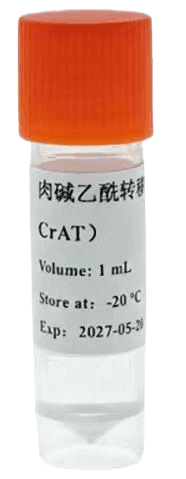
Recombinant CrAT catalyzes reversible acetyl-group transfer between acetyl-CoA and L-carnitine. It is intended for carnitine assays and energy-metabolism research.
Reference price: ¥600 / 1mL
Technical Overview
Carnitine acetyltransferase (CrAT) reversibly transfers an acetyl group between acetyl-CoA and L-carnitine, producing acetylcarnitine and free CoA. In mitochondrial metabolism, this reaction helps buffer the acetyl-CoA/CoA balance and is relevant to fatty-acid oxidation and energy metabolism.
The recombinant enzyme is produced in E. coli and purified after fermentation. The stated activity is at least 50 U/mg and the product is supplied as a liquid for assay-development and research use.
Specifications
- Activity ≥50 U/mg
- Purity ≥99%
- Liquid formulation
- Pack size: 1 mL
Applications
- Diabetes and metabolic-disease research
- Exercise rehabilitation research
- L-carnitine detection
- Inherited-disease screening research
Product Features
- High enzyme activity
- Stable production source
- High purity
- Good repeatability
- Good stability
Source and Storage
- Source
- Recombinantly expressed in E. coli and purified after fermentation.
- Storage
- Store at −20°C and avoid repeated freeze–thaw cycles. Short-term storage at 4°C is possible.
Patent Application
Method for Constructing Recombinant Carnitine Acetyltransferase and Its Applications
Related invention patent application No. 202610517825.3 entered substantive examination on 2026-06-12. This does not mean the patent has been granted or the product certified.
Frequently Asked Questions
What does CrAT do in living systems?
CrAT catalyzes reversible acetyl transfer between acetyl-CoA and carnitine, producing acetylcarnitine and CoA. It participates in mitochondrial fatty-acid oxidation and energy metabolism and is relevant to related research.
What are traditional CrAT sources and limitations?
The source FAQ describes extraction from pigeon muscle, with limited supply, stability and batch consistency. Recombinant expression is intended to provide a more controlled source with stated activity ≥50 U/mg.
What is the product's source?
Double Win's CrAT is expressed in E. coli and purified after fermentation. The source FAQ describes it as a high-purity, high-activity recombinant preparation with activity ≥50 U/mg.
What is its activity?
The stated activity is ≥50 U/mg. Higher activity can improve catalytic output at a given enzyme dose, subject to the actual assay and process conditions.
What is its purity?
The E. coli-expressed enzyme is purified after fermentation. The product catalogue states purity ≥99%; batch-specific quality-control results should be checked for delivered material.
What advantages does it offer over extracted enzyme?
The listed advantages are activity, a stable production source, purity, repeatability and stability, with reduced dependence on animal-tissue extraction.
How is CrAT relevant to disease-treatment research?
CrAT is studied in metabolic pathways associated with diabetes and cancer. The recombinant enzyme can be used as a research reagent for mechanistic studies, screening and target validation; it is not a therapeutic product.
How is CrAT relevant to exercise rehabilitation?
Because CrAT participates in energy-metabolism regulation, it may support research on exercise capacity and fatigue. The product is an enzyme reagent for related research.
What are its detection and screening uses?
The enzyme may be evaluated for L-carnitine assays and inherited-metabolic-disease screening research. Validate sensitivity and stability within the particular assay.
Can CrAT be used to detect L-carnitine?
Yes, its reversible reaction with acetyl-CoA and carnitine can be incorporated into an enzymatic assay. The product is a candidate enzyme ingredient for L-carnitine assay development.
Can CrAT be used in inherited-disease screening?
The source FAQ discusses research involving abnormal CrAT activity and inherited metabolic disease. Suitability for a screening assay requires method-specific validation and regulatory compliance.
What is its value in metabolic-disease research?
CrAT is involved in mitochondrial fatty-acid oxidation and energy metabolism, making it relevant to mechanistic studies and target screening in diabetes, obesity and related conditions.
Can CrAT be used in drug screening?
It may serve in research screening of compounds targeting related metabolic pathways. Enzyme consistency and assay conditions must be validated for the screening platform.
Is CrAT relevant to cancer research?
CrAT is studied in metabolic reprogramming. Recombinant CrAT can be used as an enzyme reagent for cancer-metabolism research, not as a clinical treatment.
Can it support sports-nutrition product research?
The source discusses CrAT's role in energy metabolism and possible research into exercise tolerance and fatigue. Any finished-product health claim requires independent evidence and regulatory review.
In which fields may CrAT be applied?
The source groups applications into metabolic-disease research, exercise-related research, and L-carnitine or inherited-disease assay development. It also mentions mechanistic studies and compound screening. The product's stated activity is ≥50 U/mg.
Technical Inquiry
For batch-specific specifications, storage conditions, suitability and application guidance, contact our team with your target substrate and use case.
Contact us →