Starch Assay Kit
Detection enzymes and reagents
Product Overview
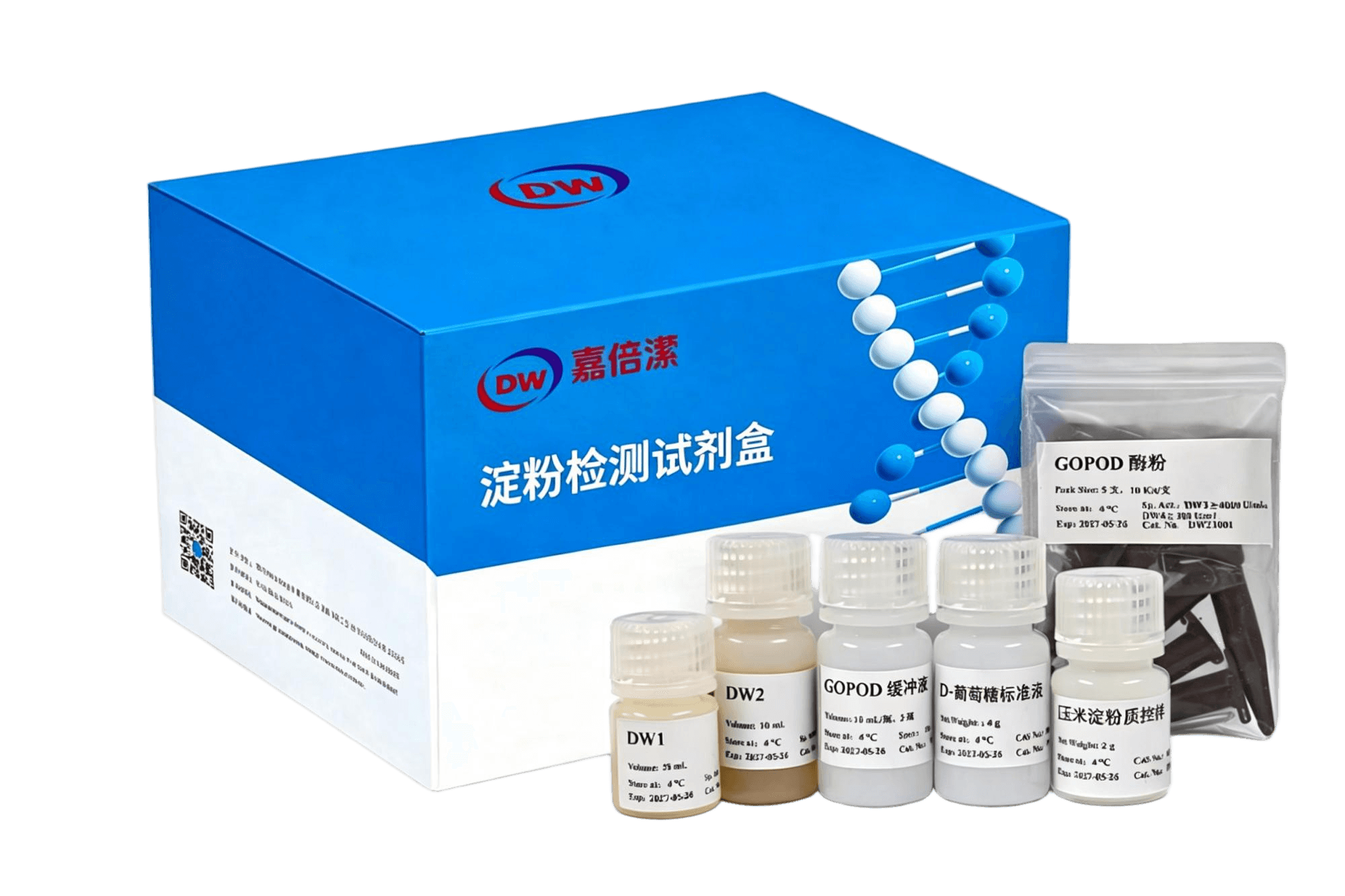
An assay kit for starch-related analytical testing. Select the method and sample preparation conditions for the target material.
Reference price: ¥700 / 套
Technical Overview
The assay combines multiple enzymatic steps. Thermostable α-amylase breaks down starch into smaller carbohydrates, glucoamylase produces glucose, and a glucose oxidase/peroxidase system generates a measurable color signal.
A glucose standard curve relates absorbance to concentration. Sample preparation, blanks, dilution and the supplied instructions are essential to reliable starch quantitation.
Specifications
- α-Amylase ≥4,000 U/mL
- Glucoamylase ≥2,000 U/mL
- GOPOD colorimetric system
- 100 tests per kit
Applications
- Starch testing in foods
- Starch testing in feed
- Starch testing in plants and grains
Product Features
- Simple operation
- Fast testing
- Accurate and stable results
- Wide sample applicability
Source and Storage
- Storage
- Store sealed and protected from light at 2–8°C; do not freeze.
Patent Application
Starch Content Assay Kit and Detection Method
Related invention patent application No. 202610081622.4 entered substantive examination on 2026-04-10. This does not mean the patent has been granted or the product certified.
Frequently Asked Questions
What does the starch assay kit measure?
It quantitatively measures starch in foods, feeds, plants and grains. Enzymes convert starch step by step into measurable glucose, followed by a glucose oxidase/peroxidase color reaction. The method is designed for simple operation, rapid testing and stable results.
How does the assay work?
An α-amylase first hydrolyzes starch to smaller sugars. Glucoamylase then generates glucose. A glucose oxidase/peroxidase system produces a color signal, and absorbance is used to calculate starch content.
Why use an enzymatic method for starch?
Enzymatic testing uses relatively mild conditions, has good selectivity and a comparatively simple workflow. The coordinated enzymes reduce the impact of complex sample preparation across food, feed and plant matrices.
What are the kit components?
The multi-enzyme system includes thermostable α-amylase, glucoamylase, glucose oxidase/peroxidase color reagents, associated reaction reagents and standards. Enzyme sources, amounts and conditions are optimized as an integrated assay.
Why are both α-amylase and glucoamylase needed?
Starch is structurally complex. α-Amylase breaks large molecules into dextrins and oligosaccharides; glucoamylase further converts these products into glucose for the final colorimetric reaction.
What does α-amylase do in the kit?
It hydrolyzes internal α-1,4-glycosidic bonds, turning starch into dextrins and shorter sugars ahead of saccharification. The stated α-amylase activity is ≥4,000 U/mL.
What does glucoamylase do?
It further hydrolyzes starch products, including dextrins and oligosaccharides, into glucose for the glucose oxidase/peroxidase reaction. Its stated activity is ≥2,000 U/mL.
What is the role of glucose oxidase/peroxidase?
Glucose oxidase produces hydrogen peroxide from glucose. Peroxidase then drives a reaction with a chromogenic substrate; the change in absorbance reflects glucose generation and indirectly the starch level.
Why can starch be calculated from glucose?
Starch consists of glucose units linked by glycosidic bonds. After sufficient enzymatic hydrolysis, the resulting glucose is measured against a standard curve and converted to starch content with the appropriate calculation.
How does this differ from a single-amylase assay?
A single enzyme mainly addresses part of the hydrolysis step. This kit combines starch breakdown, saccharification and colorimetric detection into a complete quantitative workflow.
Why optimize four enzymes together?
Activities do not simply add up. Enzyme source and amount, reaction time and conditions, and interactions between enzymes all influence the final signal. Joint optimization improves matching between reaction steps, stability and efficiency.
What are the main technical advantages?
The integrated enzyme system combines hydrolysis, saccharification and color development. It aims to be simple, fast, accurate, stable and broadly applicable to food, feed and plant samples.
What is distinctive about its α-amylase?
The kit uses a high-activity thermostable α-amylase with a stated activity of ≥4,000 U/mL. Its activity supports rapid hydrolysis, while thermostability helps it tolerate assay conditions.
What is the glucoamylase activity?
The stated activity is ≥2,000 U/mL. Together with α-amylase, it supplies glucose from hydrolysis products for the colorimetric step.
How is the standard curve prepared?
Prepare D-glucose standards at different concentrations, plot absorbance against glucose concentration and fit a line. Convert the sample absorbance to glucose concentration, then account for preparation and conversion factors to obtain starch content.
What detection wavelength is used?
The current product material shows a standard curve measured at OD510. In practice, follow the wavelength and color-development conditions in the supplied instructions.
What is the standard-curve range?
The validated D-glucose standard-curve range shown in the current material is 0–1.2 mg/mL. Dilute samples as needed so results fall within the valid range.
Why include blanks?
Sample color, reducing substances and other matrix components can affect absorbance. Sample and reagent blanks, together with standards, help remove background signal and improve quantitation.
Is sample pretreatment necessary?
It depends on the matrix. Homogenize complex food, feed or plant samples and choose appropriate extraction, dissolution or dilution. Pretreatment improves starch release while reducing interference with enzyme and color reactions.
Why can different dilutions give different results?
Dilution changes both starch concentration and matrix interferents. Too little dilution can exceed the standard curve or cause inhibition; too much can weaken the signal. Choose a valid range and compare parallel dilutions.
Which samples are suitable?
The kit is intended for starch in foods, feeds, plants and grains. Optimize pretreatment and dilution for composition, starch level and matrix complexity.
Is the assay fast?
Integrating hydrolysis, saccharification and color development can reduce handling between steps. Follow the reaction times in the product instructions for the actual assay.
How reproducible is the kit?
The four-enzyme system was jointly optimized for stability and repeatability. The current validation material reports approximately 97% repeatability.
How stable is the kit?
Sealed packaging and optimization of individual enzyme components support storage stability. Current validation indicates more than six months, but use the expiry date and conditions on the batch label and instructions.
How should the kit be stored?
Keep sealed and protected from light at 2–8°C. Avoid repeated freezing and thawing and prolonged heat exposure. Follow the product label and instructions for the delivered batch.
What is its advantage over traditional starch assays?
The kit integrates thermostable α-amylase, glucoamylase and glucose oxidase/peroxidase color development, with enzyme amounts and reaction conditions jointly optimized. This supports a faster, more standardized and reproducible quantitative method than workflows requiring many separate manual steps.
Why not simply increase enzyme activity to improve accuracy?
The assay is a coupled multistep system. Accuracy also depends on enzyme ratios, matched reaction rates, substrate conversion and the color system. Increasing one enzyme alone may not help; the whole reaction needs optimization.
Why does multi-enzyme coordination matter?
Different enzymes handle starch breakdown, saccharification and signal generation. Matching their amounts and conditions allows each product to feed the next step, reducing intermediate buildup and incomplete-reaction error.
Why use standards for quantitation?
Standards establish the relationship between concentration and signal. A standard curve converts sample absorbance to concentration, after which sample preparation and dilution factors yield final starch content.
Technical Inquiry
For batch-specific specifications, storage conditions, suitability and application guidance, contact our team with your target substrate and use case.
Contact us →